
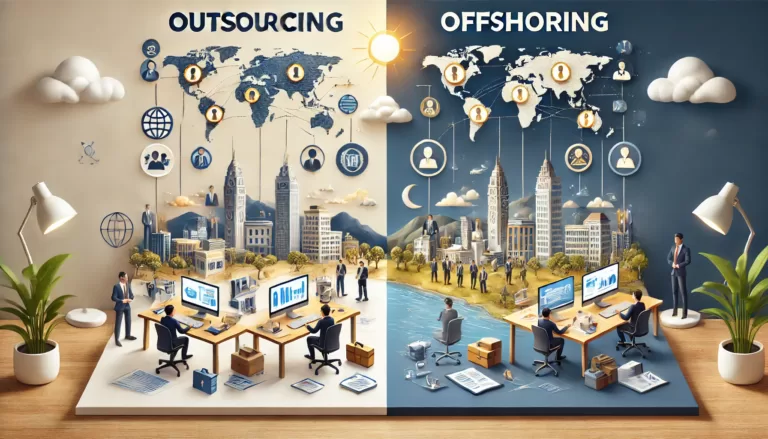
Outsourcing and offshoring are powerful strategies that businesses use to optimize operations, enhance efficiency, and reduce costs. However, these terms are often misunderstood or used interchangeably. Outsourcing refers to delegating specific tasks or services to third-party providers, whether locally or globally, allowing companies to focus on their core competencies while benefiting from specialized expertise (Smith, 2021). In contrast, offshoring involves relocating business processes to another country, either through partnerships with foreign vendors or by establishing owned facilities. This approach is primarily motivated by cost savings, access to skilled global talent, and the ability to tap into emerging markets (Brown & Lee, 2020).
The key difference lies in location and ownership. Outsourcing focuses on who performs the work, whereas offshoring centers on where the work is performed. While outsourcing can involve local or overseas providers, offshoring specifically targets international locations for economic and strategic advantages. Both strategies present unique opportunities and challenges, such as managing cultural differences in offshoring or ensuring quality control in outsourcing (Deloitte, 2022).
Understanding these distinctions helps businesses make informed decisions based on their objectives, whether it’s leveraging local expertise through outsourcing or achieving global scalability through offshoring. For further insights into crafting the right strategy, see Optimum Offshoring.
Offshoring Benefits:
Lower Costs: Achieves significant savings by operating in countries with lower wages and expenses.
Global Talent Pool: Accesses a wide range of skilled professionals in offshore locations.
Market Expansion: Establishes a presence in international markets, catering to local customers.
Risk Diversification: Reduces dependency on a single geographic location.
Outsourcing Benefits:
Cost Savings: Reduces operational expenses by leveraging external providers.
Access to Expertise: Brings in specialized skills and knowledge unavailable in-house.
Flexibility: Adapts quickly to changing demands or market conditions.
Focus on Core Competencies: Frees up internal resources to focus on strategic goals.

